Garbage Disposal Repair and Replacement, Done in One Visit
A disposal fails in one of three ways, and each one means something different. It hums but nothing turns. It trips the reset button again and again. Or there is a slow drip under the sink that smells worse every day. We handle all three across Frisco, Plano, and the surrounding cities, usually the same day you call.
You reach our own team, not an answering service. Searched for a plumber near me because the sink is full and the disposal just clicks? A licensed plumber arrives with a new unit already on the truck, and you hear the full price before anything comes apart. If the fix is a jam and a five minute reset, that is what you pay for.
Humming, Tripping, Leaking: What Each One Means
A disposal that hums but will not spin is jammed. Something hard is wedged between the impellers and the motor is fighting it. Caught early, that is often a quick fix and the unit lives on.
A disposal that trips its reset every week is a tired motor telling you how the story ends. It still works, right up until it does not.
A disposal leaking from the bottom is done, no exceptions. That is the internal seal or the housing itself, and neither is repairable. Anyone who tells you otherwise is selling you a visit.
If the cabinet floor under the sink is already soaked, deal with it sooner rather than over the weekend, because water sitting on particle board swells it permanently and then the cabinet becomes the expensive part. While we are under there, the supply lines and shut-off valve replacement usually deserve a look too, since the parts under a sink tend to age together.
Here is the honest version, and we would rather you hear it from us than learn it twice: disposals mostly do not get repaired. Outside of a simple jam or a loose drain connection, once a unit starts causing problems the smart money says replace it. Paying twice to nurse a rusting motor costs more than one clean swap.
Why Cheap Builder-Grade Units Die Young
Most of the failed disposals we pull out share the same biography: a basic 1/3 or 1/2 HP unit, installed by the builder because it was the cheapest thing that passed inspection, in a house where somebody actually cooks. Undersized for the household, it grinds slowly, clogs often, and wears out fast.
The short manufacturer warranty on those units tells you everything. Even the factory does not expect them to live long. They rust from the inside out and eventually leak from the bottom, and that leak, as you now know, has no cure.
From our experience across thousands of kitchens here, 3/4 HP is the sweet spot for a normal family of three or four who cook regularly. It grinds faster, jams less, runs quieter, and lasts. 1 HP makes sense for large households and heavy cooks. 1/2 HP only belongs in a kitchen that barely gets used.
Use It or Lose It
This surprises people: a disposal that sits unused dies faster than one that works every day. Run it rarely and grease and food residue settle inside, the moving parts gum up, and rust gets its foothold. Then one morning it just hums.
Our advice on every install: run it every day or two with cold water, even for a few seconds with nothing in it. It keeps the parts moving, flushes residue toward the drain, and adds years to the unit.
And the short list of what never goes in, regardless of horsepower: grease, coffee grounds, bones, fibrous peels, and eggshells by the bowl. A good share of the kitchen backups we clear started with a disposal being treated like a trash can.
The Dishwasher Connection Most People Never Check
Here is something we find constantly, and homeowners are usually surprised by it. The dishwasher drains through the disposal, and that connection has to be protected so water can only travel one direction. Code allows two ways to do it: an air gap, the small chrome fitting you sometimes see on the counter behind the faucet, or at minimum a high loop, where the drain hose is secured up under the countertop before it comes back down to the disposal.
When neither is there, the hose runs low and flat, and gravity does what gravity does. If the sink backs up or the disposal clogs, that dirty water has an open path straight into the bottom of your dishwasher. People run a cycle, wonder why dishes come out smelling wrong, and never connect it to the sink.
We see it in new builds and old ones alike. Sometimes it gets missed during a fast installation, sometimes a dishwasher was swapped later by someone in a hurry, and sometimes a homeowner did the swap themselves without knowing the detail existed. Nobody sets out to do it wrong. So whenever we are already under your sink, we look, and if the loop is missing we secure it properly as part of the job rather than leaving it for you to find out the hard way.
What We Install and What It Costs
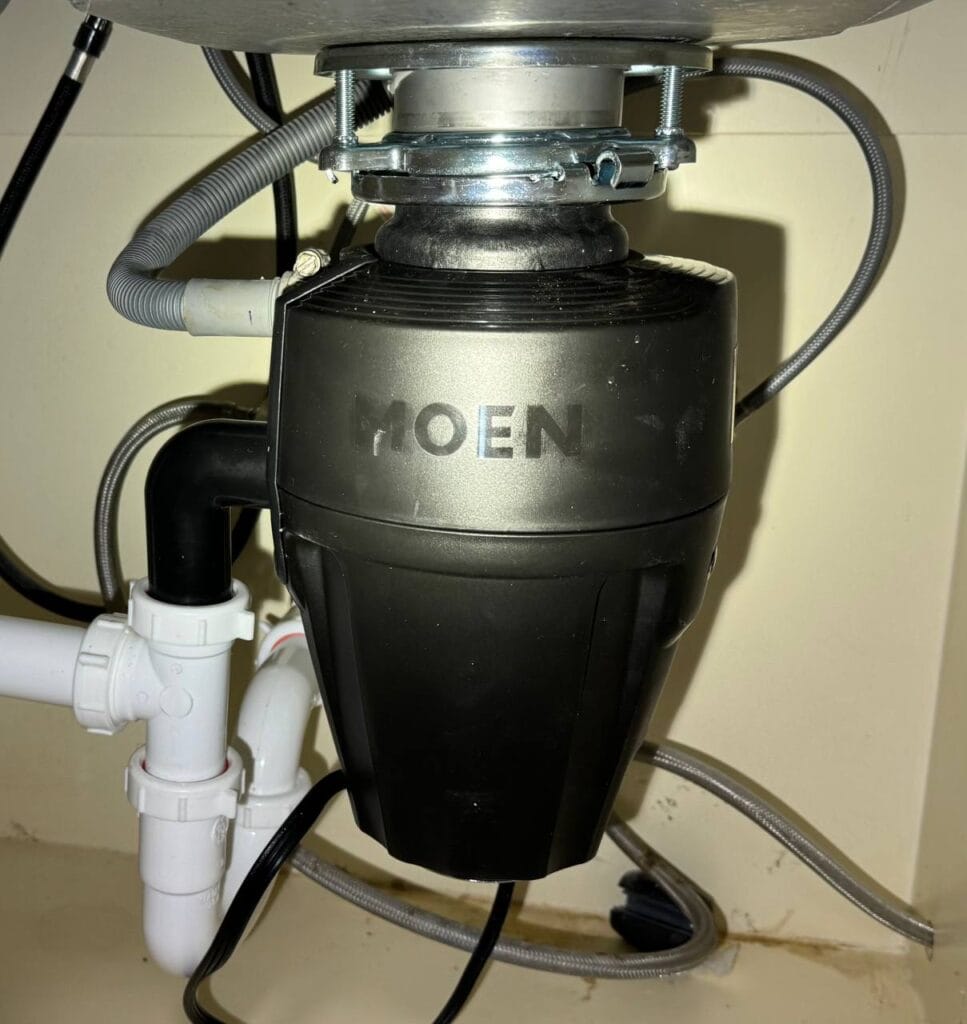
Our standard unit is a Moen 3/4 HP disposal backed by a 10-year manufacturer warranty, one of the longest in the business. If anything happens to the unit inside those ten years, the manufacturer sends you a new one free. That warranty length is the factory betting on its own build quality, and it is why we stopped installing the cheap stuff.
The numbers, up front as always: $229 for professional installation if you supply your own unit, or $400-500 complete with our Moen 3/4 HP installed, sealed, and tested.
What that price actually covers, because this is where other companies start adding lines to the invoice. We replace the drain trap and the tailpiece rather than reusing tired parts that will weep in six months, fit new rubber gaskets and the sink flange seal, connect the dishwasher line properly with a fresh clamp, mount the unit square so it does not vibrate itself loose, run water through it and check every joint under the sink for leaks before we pack up, and haul the old unit away with us. No separate parts bill afterward. The price you hear before we start is the price you pay after.
Disposal Quit Mid Dinner Prep?
Same day is the normal case. You call, we name a real window, and the swap itself usually takes under an hour. Nights and weekends run through our emergency plumbing line with the after hours fee named before we roll out. Wherever you are, from Frisco to Plano, McKinney, Allen, or Little Elm, the truck is usually nearby.
Garbage Disposal FAQ
How much does garbage disposal installation cost?
$229 for installation if you supply the unit, or $400-500 complete with our Moen 3/4 HP disposal, installed and tested, backed by a 10-year manufacturer warranty.
My disposal hums but does not spin. Is it dead?
Not necessarily. A hum usually means a jam, and caught early it is a quick fix. But if the motor keeps tripping the reset or the unit is old, that hum is the beginning of the end.
My disposal leaks from the bottom. Can it be repaired?
No. A bottom leak means the internal seal or the housing has failed, and there is no fix for that. Replacement is the only real answer, and waiting soaks the cabinet underneath.
What size disposal do I actually need?
From our experience, 3/4 HP is the sweet spot for a normal family of three or four with everyday cooking. 1 HP for large households and heavy cooks. 1/2 HP only for kitchens that barely use it.
How often should I run my disposal?
Every day or two with cold water, even briefly with nothing in it. Units that sit unused collect grease and residue, gum up, rust, and die young.
Can you install a disposal I bought myself?
Yes, that is the $229 option. We mount it properly, connect the dishwasher line, leak test everything, and haul away the old unit
Why does my dishwasher need an air gap or a high loop?
Because without one, a backed up sink or a clogged disposal can push dirty water straight back into the dishwasher. Code calls for an air gap or at minimum a high loop in the drain hose, and it is one of the most commonly missed details we find under kitchen sinks.
What Our Customers Say
Real Google reviews from local homeowners.

Tell us what the disposal is doing and we will tell you whether it is a repair or a replacement before anyone comes out.
