
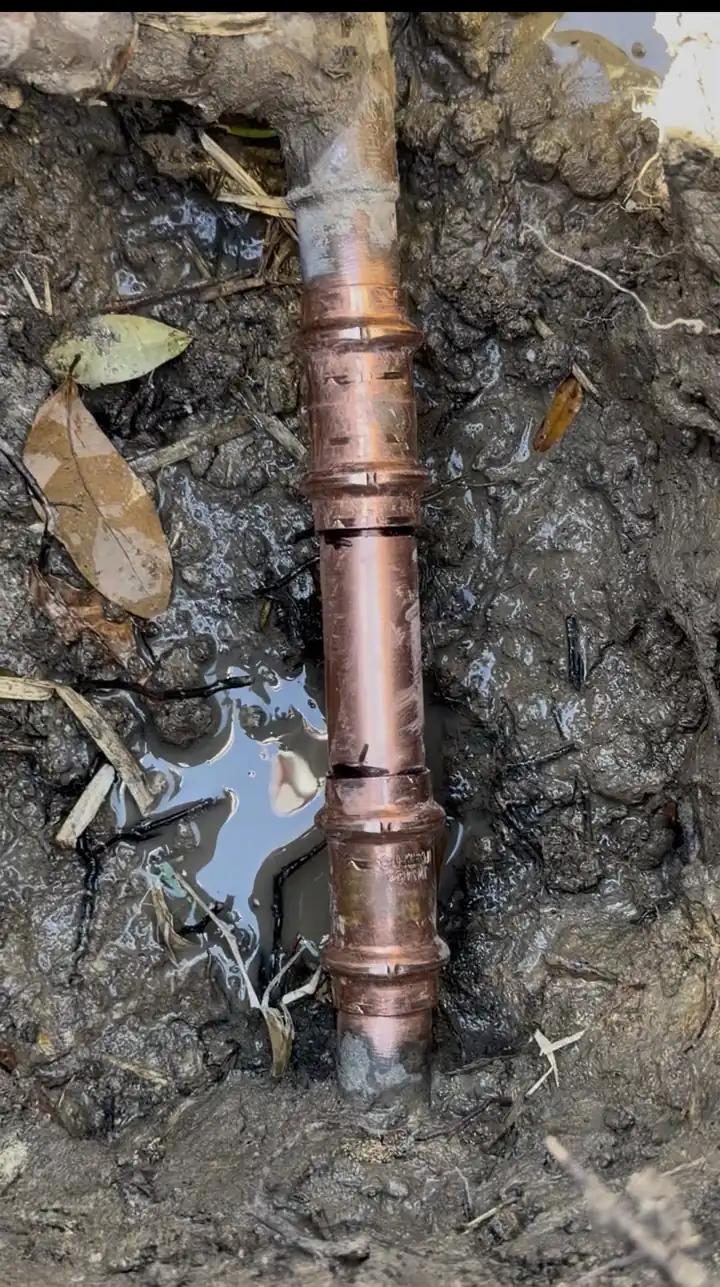

Signs of a Main Water Line Leak
It almost always follows the same progression.
The bill climbs first, usually twenty or thirty dollars, and everybody blames the sprinklers or a long month. Nobody calls a plumber over that.
Then the ground gives it away. A patch stays soft when everything around it is dry, or one strip of grass turns noticeably greener because it is being watered around the clock. In August that strip stands out like a stripe.
Then the pressure drops, and importantly it drops everywhere at once, not at one fixture. That is what separates a line problem from a cartridge or an aerator.
And underneath all of it, the meter settles the question: with every tap in the house closed, a leak indicator that keeps moving means water is leaving the system somewhere.
Sometimes it skips the whole sequence and simply blows, and then you have water bubbling up through the lawn and you are hunting for the shutoff. That version is rarer but it is the one people remember.
If that is where you are right now, shut the main before anything else. Our shut-off guide shows where that valve sits in houses around here, and knowing it in advance is worth more than any tool in your garage.
Water Line Responsibility: Yours or the City’s
This one saves people real money, so we check it before anything else.
Everything from the meter to your house is yours. Everything from the meter out to the street is the city’s, and if the failure sits on their side, the repair is theirs and it costs you nothing but a phone call.
We verify which side the wet ground is on first, every single time, and we tell you straight even when the answer means the job is not ours. That has cost us work. It has also brought a lot of the same people back later with something that was ours to fix.
Locating an Underground Water Line Leak
Digging to look is how a contained repair turns into a landscaping bill, so the shovel comes out last, not first.
We confirm the loss at the meter, isolate the yard from the house so we know the water is going into the ground and not into a wall, then trace the run with pressure readings and acoustic equipment until we can mark the ground and stand behind that mark. The equipment and the method are the same ones laid out on our leak detection page, pointed at the yard instead of the walls.
Only then does anyone talk about cost, and at that point the number is based on a known location instead of a worst case guess. Two companies quoting the same leak can be thousands apart purely because one of them located it and the other one is pricing in the risk of not knowing.
Water Line Leak at the Foundation: Copper Set in Concrete
Here is a failure most homeowners have never heard of, and we find it more often than anyone would like.
Where the water line reaches the house it has to get through the foundation. Done properly it passes through a sleeve, so the copper never touches concrete and has room to move. Done in a hurry, the pipe is simply set into the pour. Concrete is alkaline and it works on copper slowly. The foundation also breathes with the seasons, and every cycle grinds the pipe against the material holding it. Give that fifteen or twenty years and the line fails at exactly the worst spot: buried inside the foundation itself.
A recent job shows how it goes. The homeowner had a soaked front yard, a meter reading a steady 0.2 gallons per minute with everything in the house shut off, and a notice from the city about excessive consumption, which is often the first official warning people get.
We pressurized the line with fifty PSI of air and walked it with an acoustic locator. The bubbling came back right at the edge of the foundation, about three feet from the secondary shut-off valve sitting in its box in the ground. We opened an access pit there and found the reason: past the shut-off the line split into a three quarter inch branch and a half inch branch, and both ran directly into the concrete with no sleeve around either one. Water was coming out of the foundation itself where the half inch line had failed, a jet straight out of the concrete.
Reaching it meant tunneling roughly five to six feet under the foundation. By that point the job had stopped being a yard repair and turned into what is effectively a slab leak repair: the failure sat under the slab, and the access is the same tunnel we dig for one. Once we were on the pipe we found the copper below the slab in good condition, so we cut it there, cut again just past the shut-off where the branch started, brazed the new connections, and ran the replacement line underneath the foundation instead of through it. No concrete contact anywhere on the new run. Pressure tested it, backfilled, done. The yard dried out and the meter stopped moving.
The price of work of that kind depends on how deep the line sits, how far the tunnel has to run, and what is sitting on top of it. You get the actual number after we locate the leak, not before, because quoting that job from the driveway would be guesswork with your money.
Water Line Repair vs Full Replacement
This is the real decision and the answer is different from house to house.
A spot repair fits a line that is otherwise sound and failed at one point for a specific reason: newer pipe, no history of trouble, damage from a root or from somebody’s shovel. Cut out the bad section, put in new, backfill, done. Faster and considerably cheaper.
A full replacement fits a line that is telling you it is finished: old galvanized, aging copper that is failing from age rather than from an event, or a line that has already been repaired once and is now leaking somewhere else. Repairing that pipe is buying time at full price, and the next call comes anywhere from six months to two years later.
Where the route allows it, a new line can be pulled without trenching the entire run, which keeps the yard mostly intact. Where it does not, you see that in the estimate rather than discovering it when the machine arrives.
We tell you which one we would do at our own house, with a real number on each, and then the choice is yours.
Tree Roots and the Water Line
Older lots around here carry trees that have been growing longer than the plumbing has been in the ground, and roots follow moisture without caring what is in the way.
A plumber in McKinney sees this one a lot. On one job there a large tree in the front yard had grown into the service line and damaged the copper outright. Clearing around it and patching the pipe would have been a repair with an expiry date stamped on it, because the tree was not going anywhere and neither was the root system. That section came out and got replaced.
That is the reasoning worth understanding: when a tree caused the failure, patching the pipe beside the same tree is not a fix, it is a postponement.
Older lots like these are where a plumber in Plano or a plumber in Carrollton spends a lot of time, because the trees went in with the houses. Newer ground is the opposite problem: a plumber in Prosperor a plumber in Celina meets young lines with shallow trenching and connections that were rushed.
What Else It Might Be
Not every high bill is a water line, and it is worth ruling out the cheaper answers.
If the wet ground is inside rather than outside, that is leak detection work. If the floor is warm and the yard is dry, that is a slab leak. If pressure is the only symptom and nothing anywhere is wet, check the PRV before assuming the worst, because a failed pressure reducing valve produces the same complaint for a fraction of the cost. And if the soft ground sits right next to a sprinkler head, start with the irrigation.
One more line for the version that cannot wait: if the line has already let go and water is coming up through the yard or into the house right now, that is not a research project. Shut the main and call the emergency plumbing line: it runs nights, weekends and holidays, and you hear the after hours fee before the truck moves.
Water Line FAQ
How do I know if my main water line is leaking?
The yard tells you first: a patch that stays soft when everything around it is dry, one strip of grass greener than the rest, or a depression near the meter box. Add a water bill that climbed with no change in habits and pressure that dropped across the whole house, and the line is the first suspect. A leak indicator on the meter that keeps moving with every tap closed confirms water is leaving the system.
Am I responsible for the water line, or is the city?
From the meter to your house is yours. From the meter to the street is theirs. We verify which side the problem is on before anything else and tell you honestly, even when it means the job is not ours.
Do you have to dig up my whole yard?
No. We locate the leak with equipment rather than by digging to look, and where the route allows it a new line can be pulled without trenching the full run. How much yard gets disturbed depends on where the failure sits, and you see that in the estimate before anyone starts.
Should I repair the section or replace the line?
A spot repair fits a sound line that failed at one point. Replacement fits a line that has already failed once or is aging out. You get both priced, along with which one we would choose ourselves.
Can tree roots damage a water line?
Yes, and on older lots it is common. Roots follow moisture and grow against the pipe until it gives.
Why did my water pressure drop everywhere at once?
Pressure that falls across the whole house points at something upstream of the fixtures, which usually means the water line or the pressure reducing valve. A gauge reading tells us which one in a few minutes.
The city sent me a notice about high water usage. What now?
That notice usually means a leak has been running long enough to show up in their billing. Start with the meter test: shut everything off and see whether the dial keeps moving. If it does, the water is going somewhere between the meter and your fixtures, and finding it before the next billing cycle is the cheapest move available.
Why did my line fail right at the foundation?
Often because it was set straight into the concrete with no sleeve. Concrete corrodes copper over time and the foundation moves against the pipe with every season. When we replace one of those, the new line goes under the foundation rather than through it.
How long does a water line repair take?
Most spot repairs finish in a day. A full replacement depends on the length of the run and what sits above it, and you get a realistic timeline with the quote rather than after the digging starts.