

What a Pressure Reducing Valve Does
A pressure reducing valve, also called a PRV or water pressure regulator, is installed on the main water service entering the house. Its job is to reduce higher city-supplied pressure and keep the pressure inside the home steady.
For residential plumbing, 40 to 80 PSI is the practical working range. The maximum pressure allowed by plumbing code is 80 PSI. Anything above 80 PSI is too high. We’ve tested homes in Frisco running at 100 to 120 PSI where the owners had no idea. High pressure feels great in the shower. It is also quietly destroying every seal and connection in the house.
Strong flow is not proof that the pressure is safe. The only way to know is to connect a pressure gauge and test the system. We also test while fixtures are running because a static reading by itself does not show whether the valve can maintain flow.
Signs a Pressure Reducing Valve Is Failing
A bad PRV can fail in either direction. It may allow too much pressure into the house, or it may restrict the water and cause low pressure.
Common signs include:
- Water pressure above 80 PSI
- Whole-house pressure that is suddenly too strong or too weak
- Pressure that starts strong and drops after 20 to 30 seconds
- A major pressure drop when two fixtures run at the same time
- Banging, humming, or vibrating pipes
- Toilets that fill slowly or repeatedly need new fill valves
- Faucet cartridges, supply lines, or shutoff valves failing more often than normal
- Water leaking from the PRV body or its connections
- A water heater relief valve that drips or opens repeatedly
- Pressure that changes from one day or time of day to another
A dripping water heater relief valve does not automatically mean the PRV is bad. Thermal expansion, the expansion tank, and the relief valve itself also have to be checked. We test the system instead of guessing. Sometimes it is subtle. Sometimes it ends in a flood.

How High Water Pressure Damages Plumbing
Pressure over 80 PSI puts extra load on every valve, seal, connector, and appliance connected to the water system. At 100 to 120 PSI, that load is extreme.
High pressure can shorten the service life of:
- Faucet cartridges, O-rings, and rubber seals
- Toilet fill valves and fixture shutoff valves
- Flexible supply lines
- Washing machine and dishwasher connections
- Ice maker and refrigerator water lines
- Water heater components
- Copper, PEX, and threaded pipe connections
The damage does not always happen all at once. A homeowner may first notice a running toilet, a leaking faucet, or a supply line that fails earlier than it should. If the same types of parts keep failing in different areas of the house, the water pressure should be tested before more parts are replaced.
High pressure also works on the lines you cannot see, including the pipes under your foundation. If fixtures keep failing and the water bill keeps climbing anyway, it may already be a slab leak.
Can a Bad PRV Cause Low Water Pressure?
Yes. A pressure reducing valve can become a restriction when the internal screen, seat, stem, or other moving parts collect mineral scale or debris.
One common pattern is pressure that feels normal when a faucet or shower is first opened, then drops after 20 or 30 seconds. The water sitting in the piping provides the initial pressure. Once the house needs continuous flow, the restricted valve cannot keep up.
Low pressure throughout the entire house can also come from a partially closed shutoff valve, a water service problem, a hidden leak, or another restriction. That is why we test pressure with the water off and again under flow. See our guide to other causes of whole-house water pressure dropping for a broader diagnosis.
If only one faucet or one shower has weak flow, the PRV is less likely to be the problem. A clogged aerator, showerhead, cartridge, or local shutoff valve is more common. FPP Plumbing also handles faucet and shower valve repairs.
How Long Does a Pressure Reducing Valve Last?
In our North Texas service work, about 5 to 15 years is common for a residential PRV. Some fail sooner and some last longer. Age alone does not prove that a valve is bad, but an older valve with unstable pressure, poor flow, corrosion, or leakage should be tested.
PRV service life depends on several conditions:
- Normal wear on the internal diaphragm, spring, seat, and stem
- Calcium and other mineral buildup inside the valve
- Rust, sand, and debris entering from the water service
- Very high or rapidly changing incoming pressure
- Water quality and the condition of the service line
- Installation quality and correct valve sizing
- Heat, freezing weather, soil movement, and outdoor exposure
- Standing water, mud, and poor drainage inside an outdoor valve box
The valve has small internal passages and, on many models, a debris screen. Scale or debris can keep it from opening fully, closing fully, or holding a stable setting. Moisture and soil attack the outside of the valve and its fittings, while mineral buildup and debris affect the inside.
The City of Frisco’s PRV guidance also notes that debris can clog the screen and that North Texas climate and soil conditions can cause service life to vary greatly.
Where the PRV Is Located in Frisco and Plano Homes
The PRV is normally installed close to the point where the water service enters the house. The exact location depends on the neighborhood, the age of the home, and how the water line was routed.
Outdoor PRVs in Front Flower Beds
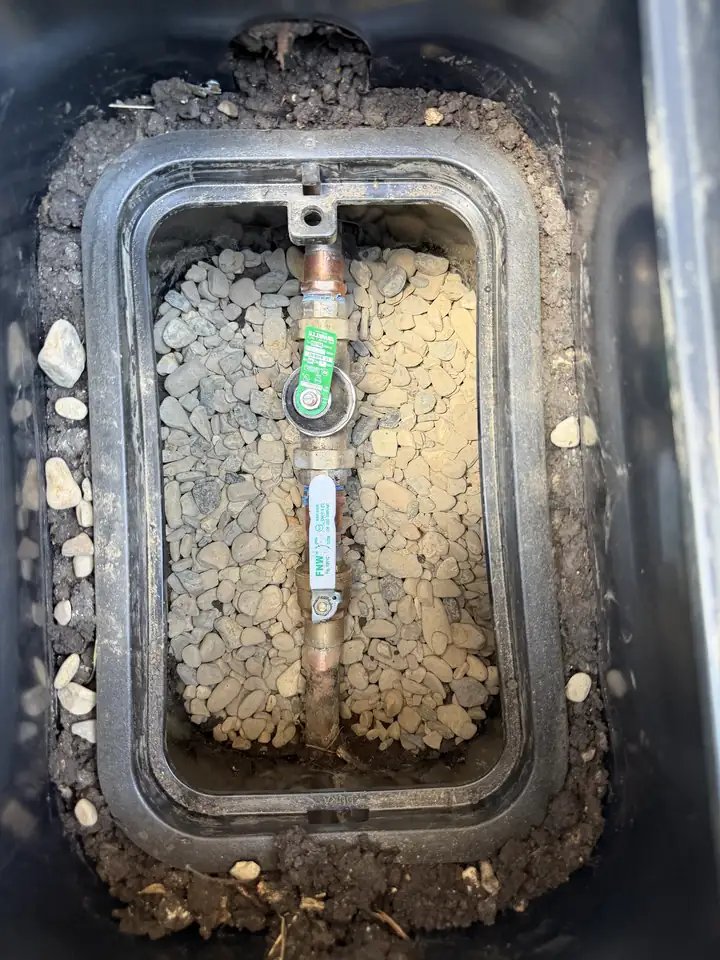
In many older homes, and in plenty of homes built through roughly the mid-to-late 2010s, the PRV is outside in the front flower bed. It may be inside a round or rectangular plastic valve box near the plumbing cleanouts, the front wall of the house, or the path of the incoming water service.
The PRV is often in the same box as, or immediately beside, the home’s secondary main shutoff valve. That shutoff is separate from the city-side valve at the water meter.
Over time, mulch, soil, plants, and landscaping can cover the lid. We also find valves that are partly buried inside the box. Some boxes stay full of mud or water from rain and irrigation. Constant moisture can corrode the valve and fittings, and it makes future testing or replacement harder.
A wet valve box does not always mean the PRV is leaking. Groundwater, rain, and irrigation can collect there too. If the box refills when the weather is dry, or the water meter moves with every fixture off, the source should be checked.
PRVs Inside Garage Access Panels
Many newer homes route the main water line into the garage and place the PRV and house shutoff behind an access panel. This is a much better service location.
The valve stays away from soil, landscaping, and most standing water. It is easier to find, easier to test, easier to adjust, and easier to replace. The shutoff is also easier for the homeowner to reach during an emergency.
If you are not sure which valve controls the house, use our guide to find and operate the main water shutoff. Do not force a buried, corroded, or seized valve. It can break and turn a pressure problem into a water leak.
Can a PRV Be Adjusted, or Does It Need Replacement?
Most adjustable PRVs have a bolt or screw on top, but turning it is not a proper diagnosis. A worn, clogged, or seized valve may not respond. Another old valve may change temporarily and then let the pressure climb again.
We check three things before making that decision:
-
Static pressure: the pressure with no water running.
-
Pressure under flow: what happens when one or more fixtures are open.
-
Pressure stability: whether the setting holds after the water is turned off and after the system cycles.
If the valve responds to adjustment and holds steady under normal use, adjustment may be all it needs. If it leaks, will not respond, restricts flow, or cannot hold stable pressure, replacement is usually the better repair.
We also separate PRV pressure creep from thermal expansion. Both can make a gauge rise, but they are not the same problem and do not always require the same repair. Sorting that out is part of our water heater repair and replacement work as well.
PRV Replacement Cost in Frisco & Plano
PRV replacement labor at FPP Plumbing costs less when the valve sits in a garage access panel, and more when it lives outside in a flower bed valve box, where digging, cleanup, and corroded fittings are part of the job. The valve itself is priced on top, sized for your specific setup. Every replacement includes pressure testing before and after, and setting the pressure where it belongs.
A seized valve or corroded piping can turn into extra pipe work, and if a City of Frisco permit applies to your job, we handle the paperwork. Either way, you get the full number before we start, not after.
One honest note: if the test shows your PRV only needs an adjustment, you pay for the pressure test and the adjustment, not for a valve you did not need. We replace what actually failed.
How FPP Plumbing Replaces a PRV
Every installation is a little different, especially when the valve has been buried or the surrounding fittings are corroded. Our normal process is:
-
Test static pressure and pressure under flow.
-
Locate the PRV and expose enough of the piping to work safely.
-
Verify the main and secondary shutoff valves before opening the water service.
-
Remove the old PRV and inspect the nearby fittings and shutoff valve.
-
Install the correctly sized valve in the correct flow direction and leave it accessible for future service.
-
Restore the water, adjust the pressure, and test multiple fixtures.
-
Check every connection for leaks and verify that the water heater’s thermal expansion is controlled.
The secondary shutoff valve is often installed beside the PRV and may be the same age. We do not assume it needs replacement. If it is seized, leaking, badly corroded, or no longer shuts the house off, we show the homeowner what we found and explain the options.
Permit requirements depend on the city and the exact scope of work. The City of Frisco states that replacing a PRV requires a permit, while repair or maintenance of the internal components does not. We verify the applicable requirements before the work begins.
PRV Replacement in Frisco and Plano, TX
Frisco’s own homeowner guidance says that a house built in Frisco after 2001 is likely to have a PRV. The city lists the most common locations as near the water meter, immediately before the service enters the home, or inside a garage wall access panel.
Plano homes use many of the same outdoor and garage configurations, but the location can change by neighborhood and construction year. We check the front valve boxes, service entrance, cleanout area, garage access panels, and the main shutoff layout before recommending any excavation or replacement.
FPP Plumbing provides residential water pressure testing, PRV adjustment, and pressure reducing valve replacement through our local Frisco plumbing team and Plano plumbing team.
Pressure Valve Questions We Get All the Time
What is normal water pressure for a house?
About 40 to 80 PSI is the practical residential range. The plumbing code maximum is 80 PSI. Anything above 80 PSI is high, and 100 to 120 PSI is extremely high.
How much does PRV replacement cost in Frisco?
Labor costs less for a PRV in a garage access panel and more for a valve buried in a flower bed box, with the valve itself priced on top. Every job includes pressure testing before and after. A City of Frisco permit may apply depending on the scope, and if the valve only needs an adjustment, you pay for the test and the adjustment, not for a new valve.
How do I know if my pressure reducing valve is bad?
Common signs are whole-house pressure that is too high or too low, pressure that drops after 20 to 30 seconds, a large drop when multiple fixtures run, banging pipes, a leaking PRV, or repeated failures of toilet and faucet valves. A gauge test under static and flowing conditions is the best way to confirm the cause.
Can a bad PRV cause low water pressure throughout the house?
Yes. Mineral scale, debris, or worn internal parts can restrict flow through the PRV. The pressure may start normally and then fall once the shower or faucet has been running for a short time.
Where is the PRV located?
In many Frisco and Plano homes, it is in a valve box in the front flower bed near the plumbing cleanouts and the secondary house shutoff. In many newer homes, the PRV and shutoff are behind an access panel in the garage.
How long does a residential PRV last?
In our North Texas service work, 5 to 15 years is common, but there is no fixed expiration date. Water quality, mineral and debris buildup, incoming pressure, installation, soil, moisture, and weather exposure can all shorten or extend its service life.
Can a plumber adjust the PRV instead of replacing it?
Sometimes. If the valve responds to adjustment and holds a stable pressure while water is running, adjustment may be enough. If it is leaking, clogged, badly corroded, unstable, or does not respond, replacement usually makes more sense.
Does PRV replacement require a permit?
The answer depends on the city. Frisco states that PRV replacement requires a permit, while internal repair or maintenance does not. Requirements can change, so the permit requirement should be verified for the property before work starts.
Does a PRV affect the water heater expansion tank?
A PRV can make the home’s plumbing act as a closed system. When the water heater heats water, that expansion still needs to be controlled. We check the expansion tank or other approved thermal expansion control instead of treating a rising pressure gauge or dripping relief valve as a PRV problem automatically.
Schedule a Water Pressure Test or PRV Replacement
We have served 4,500+ happy customers across the North Dallas suburbs, and pressure problems come up far more often than people think. If the pressure is wrong throughout the house, do not keep replacing faucet and toilet parts without testing the main system. We bring the gauge, test the pressure with water off and running, inspect the PRV and shutoff valves, and explain what is actually failing.
If the PRV can be adjusted and holds, we adjust it. If it is done, we replace it. If the PRV is not the problem, we tell you that too.
- Call or text the office closest to you
- Online: Contact FPP Plumbing
If there is an active leak, flooding, or the water will not shut off, use our emergency plumbing service.