


What a Slab Leak Actually Is
Nearly every house in Plano, McKinney and Frisco sits on a slab on grade foundation. Before the concrete was poured, the plumber trenched the ground, laid soft copper water lines in the dirt, stubbed them up through the future slab at every fixture, and left. The concrete went over the top. Those lines have been down there ever since, in wet clay, under a slab that rises and falls with every wet and dry season, with nobody able to look at them.
Where a pipe comes up through the concrete it usually runs through a short sleeve, a piece of larger pipe cast into the slab so the copper is not gripped by the concrete. The sleeve holds the pipe rigid at that one point while the rest of the line lies free in the soil. Every time the slab moves, the copper flexes right at the edge of the sleeve. That edge is one of the most common places we find the failure, and it is not always a pinhole: a line held rigid on one side and pulled on the other eventually tears.
The leak itself begins as a weep. Water under pressure works the hole like a cutting tool, and a pinhole that lost a few gallons a day in March can be dumping hundreds by August. The ground takes it all at first, which is why slab leaks run for months with nothing to show. Then the clay is saturated, the pressure has nowhere to go but up, and the water finds a crack, a joint, a sleeve or the base of a wall and comes into the house through the floor.
Where a pipe comes up through the concrete it usually runs through a short sleeve, a piece of larger pipe cast into the slab so the copper is not gripped by the concrete. The sleeve holds the pipe rigid at that one point while the rest of the line lies free in the soil. Every time the slab moves, the copper flexes right at the edge of the sleeve. That edge is one of the most common places we find the pinhole.
The leak itself begins as a weep. Water under pressure works the hole like a cutting tool, and a pinhole that lost a few gallons a day in March can be dumping hundreds by August. The ground takes it all at first, which is why slab leaks run for months with nothing to show. Then the clay is saturated, the pressure has nowhere to go but up, and the water finds a crack, a joint, a sleeve or the base of a wall and comes into the house through the floor.
We’ve seen it all: copper pipes that rusted through, poorly soldered joints that finally gave out, or homes where soil movement snapped the line clean in half. These leaks can wash away soil from under your home, damage the foundation, and send your water bill through the roof.
Signs of a Slab Leak in Plano, McKinney and Frisco Homes
- A warm or hot patch of floor, usually on tile, along a hallway or in front of a sink. A hot line leaking under the slab heats the concrete above it.
- Flooring wet from underneath: carpet damp with nothing spilled, laminate or engineered wood swelling at the seams, tile grout turning dark in a line.
- A white, chalky crust on bare concrete in the garage or on tile grout. That is mineral left behind by water evaporating up through the slab, and it is one sign most people do not connect to plumbing.
- The leak indicator on the water meter turning with every fixture in the house closed.
- A water bill that climbed for no reason, then climbed again.
- The sound of water running or hissing under the floor at night when the house is silent.
- A water heater that cycles far more than it used to, because a hot side leak is pulling heated water into the ground around the clock.
- A musty smell along a baseboard, mold at the bottom of drywall, or a door that started sticking as the slab shifted.
- Water seeping out at the edge of the foundation outside, or a strip of soil that never dries.
One of these can be something else. Two of them together, in a house with copper under the slab, is a slab leak until a pressure test says otherwise.
Why Copper Pinholes Under the Slab
Corrosion from the outside in. Copper that was laid straight against concrete corrodes where the two touch, because concrete is alkaline and stays damp. Copper lying in wet clay corrodes at every point where the soil chemistry attacks it. Copper touching rebar or a steel post-tension cable sets up a small electrical current between the two metals, and that current eats the copper. The pipe turns green, then black, then thin, and the wall of the pipe opens from the outside.
Wear from movement. Expansive clay swells when it rains and shrinks hard in a dry stretch like this year’s, and the slab rides that movement. A pipe held tight in a sleeve, or resting on a rock or a piece of construction debris, gets flexed or rubbed at the same spot thousands of times. Copper is soft. It thins at that spot until it opens.
Pressure. Anything above 80 PSI keeps a constant load on every inch of pipe and pushes a fine vibration through it. We gauge house pressure on every slab leak call, and when the number is high the fix is its own job, PRV replacement, because a brazed repair under a house running at 100 PSI will not be the last leak in that line.
Workmanship. Copper that was kinked during the pour, a joint that was soft soldered instead of brazed, a fitting buried under the slab where code wanted a continuous run, a pipe cast straight into concrete without a sleeve. We have opened lines in houses less than ten years old and found all of it. Age makes slab leaks likely. Bad installation makes them certain.
The Soil Moves, the Foundation Moves, the Pipe Tears
This is the part of a slab leak that nobody explains, and it decides where the pipe fails. The clay under Plano, McKinney and Frisco is expansive: it swells when it soaks up a wet spring and shrinks when a summer like this one bakes it. The foundation sitting on that clay rises and falls with it, and it does not move evenly. The edges dry out and drop first, the middle stays put, and the slab tilts and twists a little every season.
The copper under the slab is not free to follow that movement. It is gripped at every sleeve where it comes up through the concrete, held at every fitting, pinned under every grade beam it passes beneath, and resting on whatever rock or debris was left in the trench. Between those points it is soft copper lying in dirt. So when the foundation moves, the pipe bends and stretches at the exact spots where it is held, thousands of times over twenty or thirty years. A pipe that was already thinned by corrosion opens a pinhole there. A pipe that was still sound gets pulled until it splits at the sleeve or the joint gives way, and that is not a slow weep, that is an active leak from the first day, dumping water under the house until somebody notices the meter.
That is also why a foundation that is already moving from a leak makes the leak worse. Soil washes out, the slab drops on that side, the pipe gets pulled harder, the hole gets bigger. The two problems feed each other, and the only way to stop it is to fix the pipe first.
Slab Leak Detection: Finding the Pinhole Under the Slab
The water rarely surfaces where the pipe failed. It travels along the outside of the pipe, inside a sleeve, through the gravel under the slab, and comes up wherever the concrete lets it, sometimes ten feet away. Cutting the floor at the warm spot is how homeowners end up paying for a hole in their tile and still having a leak.
So the order never changes. First the meter, to confirm water is leaving the system with everything closed. Then we shut the cold inlet on the water heater: if the meter stops, the leak is on the hot side, and that already narrows the search to one set of lines. Then each side is isolated and pressure tested with a gauge. A line that holds is not the problem. A line that bleeds down is, and a burst of air pressure on that isolated line makes the pinhole loud enough to hear through the concrete with a ground microphone. We trace the path of the pipe with a locator, listen in a grid along it, find the loudest point, and mark it on your floor. A thermal camera confirms a hot line’s path. The general method, and the tests you can run yourself tonight, are on our leak detection page. When we mark a spot, that mark is where we dig, and only then does anyone talk about the cost of getting there.
One more check before any route is chosen: whether the slab is post-tension. Most homes built here since the 1990s are, with steel cables under tension running through the concrete. You do not cut into a post-tension slab without locating the cables first, and on those houses tunneling is nearly always the answer.
Slab Leak Repair by Tunneling Under the Foundation
This is how most slab leaks in Plano, McKinney and Frisco get fixed, and it is why your tile does not have to come up. We start outside, at the closest point of the foundation to the marked leak. The soil is dug out at the edge of the slab, then under the grade beam, and a tunnel is hand dug under the house toward the mark, high and wide enough to work in, shored where the soil calls for it. The dirt comes out in buckets. It is slow, physical work, and it is the reason the inside of your house stays exactly as it was.
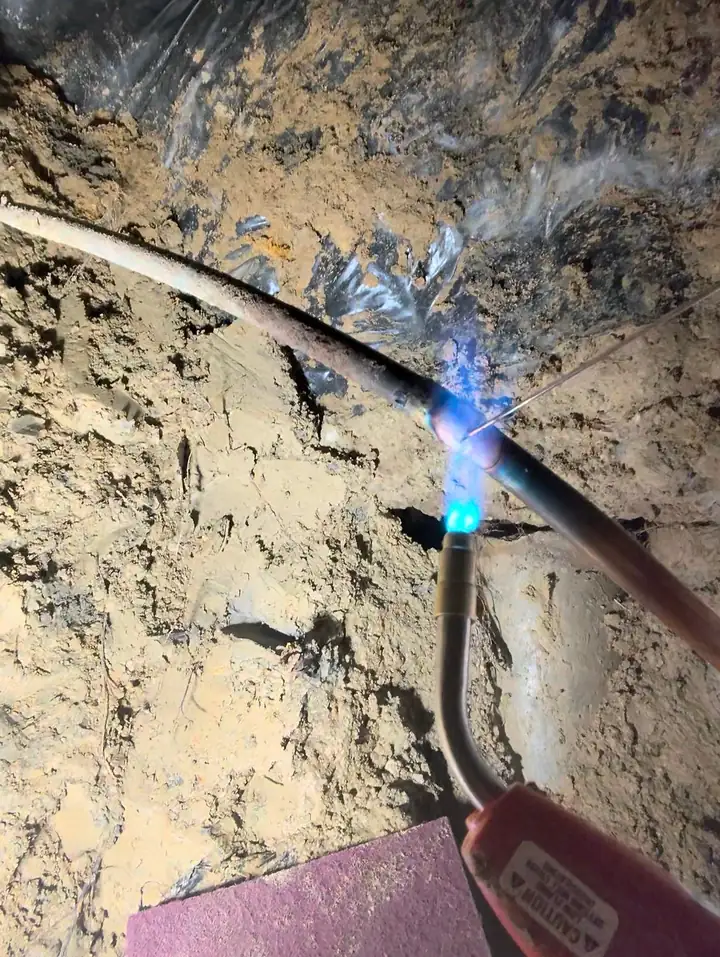

When the copper comes into view we find what the readings said we would find: a section of pipe gone green or black, thin, and weeping or spraying at the pinhole. That section is cut out back to clean, bright metal on both sides. New type L copper goes in, and the joints are brazed, not soldered. Brazing uses a filler alloy that melts at a far higher temperature than solder, and it is the only joint that belongs under a foundation, where it will never be inspected again and has to last as long as the house. The repair is protected from soil and concrete contact, the line is pressure tested with the tunnel still open so we can see the joints hold, and only then does the tunnel get backfilled in layers and compacted so the ground under the beam does not settle later.
A tunnel repair on an accessible line is usually a one to two day job. A long tunnel, or a second leak found on the same run, adds time, and you hear that before it happens rather than after.
Slab Leak Repair Through the Floor
Sometimes the shortest way to the pipe is straight down. A leak under a garage floor, a utility room or a closet, sitting close to where the readings put it, is often faster and cheaper to reach by opening the slab than by tunneling twenty feet to get there. The same goes for a leak under a slab where a tunnel would have to run beneath a driveway or a covered patio.
The work is the same in the ground and different above it. We locate any cables and rebar in the cut zone first, saw and break out the smallest section of concrete that gives us room to work, dig down to the pipe, cut out the corroded copper, braze in new pipe, pressure test, backfill and compact, and pour the concrete back level. What goes on top of that concrete, tile, wood, carpet, is flooring work, and we tell you that up front. Dust, noise and a day with a hole in your floor are the trade for a shorter route.
When One Pinhole Is Not the Only One
A pipe that corroded through in one spot has been sitting in the same soil, at the same pressure, for the same thirty years along its whole length. So after the first repair is brazed, the line goes back under pressure before the tunnel is touched, and we watch the gauge. On a Plano job the gauge kept dropping after the first pinhole was fixed, and the second one was further along the same run, close enough to reach from the same tunnel. Finding it while the ground was still open cost the homeowner a few more hours. Finding it a year later would have cost a second tunnel.
It is also why we look at the whole exposed section, not just the hole. Copper that is black and pitted a foot away from the pinhole is copper that is going to fail next, and it comes out with the bad section while we are already there.
Slab Leaks and Foundation Damage
Water under a foundation does two opposite things, and both crack houses. Where the flow is strong it carries fine soil out with it, leaving voids under the slab, and the slab settles into them: cracks in brick and sheetrock, doors that stick, a corner of the house going down. Where the flow is slow it soaks the clay, the clay swells, and the slab heaves up: cracks in the other direction and floors that are no longer flat. A leak that ran all summer can do both.
This is why the plumber comes before the foundation company. Foundation repair here means piers and lifting, and lifting a slab breaks pipes that were already weak, which is exactly why foundation contractors require a plumbing test after they level a house, a hydrostatic test on the drain lines and a pressure test on the water lines. We do those tests, before the lift if you want to know what is really under the house, and after it when the contractor asks for the report. When the foundation symptom is caused by a slab leak, we fix the leak and document it, so the foundation work, if it is still needed, is done on dry ground.
What Slab Leak Repair Costs
Four things set the price: how long it takes to locate the pinhole, which route reaches it, how far a tunnel has to run, and what sits on top of the pipe. A pinhole three feet inside the foundation under a garage floor and a pinhole under a kitchen island in the middle of a post-tension slab are not the same job, even when the hole in the copper is identical.
How it works with us: a weekday visit opens with a $49 service call, credited toward the repair. The locating is done and the spot is marked before anyone quotes anything. Then each route that fits your house, tunnel or slab cut, is priced as its own number with the permit included, and the number you approve is the number on the invoice. Evenings, weekends and holidays carry an emergency fee that depends on the hour, stated on the phone before we roll.
If a company quotes you a slab leak repair over the phone, they are quoting the average of their last ten jobs, not yours. A price built on a marked leak is the one that holds.
A Plano Slab Leak, Start to Finish
A recent Plano house shows the whole sequence. Hot side isolated at the heater and the meter stopped. Pressure test on the hot line bled down. Air on the line, ground mic on the slab, loudest point marked in the hallway. From outside, a tunnel under the grade beam to the mark. The copper came into view exactly there, black and pitted, weeping from a pinhole where it had been rubbing on a rock the builder left in the trench. Bad section cut out, new type L copper brazed in, protected from the soil, pressure tested with the tunnel open, backfilled and compacted. Nothing inside the house was touched. Inspection scheduled with the city before the tunnel was closed.
A different Plano job, on a post-tension slab, is written up in our slab leak repair guide. And the case that surprises people most, the main water line entering the foundation set straight into the concrete with no sleeve, corroded through by the concrete itself, is water line work rather than slab work, and we say so. It lives on our water line repair page.
Insurance, Documentation and Drying
We will not tell you what your policy covers, because policies differ and adjusters read them differently. What we do is give the adjuster something to work with: photos of the marked leak, the exposed pipe, the corroded section after it is cut out, the brazed repair and the test, plus a written description with the invoice. When the house needs drying, we bring in a water damage restoration company we work with regularly, so the claim has the right paperwork from both sides and the mold does not get a head start.
Slab Leak Repair Across Plano, McKinney, Frisco and the North Dallas Suburbs
The oldest copper on our schedule is under the houses a plumber in Plano sees every week, dispatched from our office on Tennyson Parkway, followed by the established streets a plumber in McKinney works around downtown. A plumber in Frisco rolls out of our Westridge Boulevard office for both the older neighborhoods near Preston Road and the post-tension slabs of the newer ones. The same trucks, the same locating equipment and the same brazing rule cover a plumber in Allen call, a plumber in Prosper or a plumber in Celina call, and on the Denton County side a plumber in Little Elm, a plumber in The Colony, a plumber in Carrollton or a plumber in Lewisville with a warm spot on the floor.
Water Coming Up Through the Floor Right Now?
Close the main valve. In most homes here it is in a box at the curb or where the water line enters the house, and our shut-off guide shows both with photos. That stops the flow into the ground and stops it coming up through the floor. Then call. Our emergency plumbing line is answered by a person at any hour, and a slab leak that has surfaced goes to the front of the schedule.
Slab Leak Repair: Real Questions from Texas Homeowners
How does water from a slab leak get into the house?
It starts underground. Water from the pinhole soaks into the clay under the slab, and for weeks the ground drinks it. Once the soil is saturated, pressure keeps pushing and the water takes the easiest path up: a crack in the slab, a cold joint, the sleeve where a pipe comes through the concrete, the gap at the base of a wall. From there it wicks into carpet pad, swells laminate from underneath, darkens grout lines, and leaves a white mineral crust wherever it evaporates through bare concrete or tile.
Why do copper pipes get pinholes under the slab?
Corrosion from the outside, wear from movement, or both. Copper laid straight against concrete or wet clay corrodes at the contact points. A pipe touching rebar or a rock gets rubbed at the same spot every time the slab moves with the seasons. Pressure above 80 PSI keeps a constant load on the metal. And copper that was kinked or poorly joined during construction fails years early. The hole starts smaller than a pin. Under pressure, water cuts it bigger every month.
Do you braze or solder the repair under the foundation?
Braze. A joint buried under a slab has to be made with brazing alloy at a much higher temperature than soft solder, because it will never be seen again and it has to outlast the house. We cut out the corroded section back to clean, bright copper on both sides, braze in new type L copper, let it cool, and pressure test it with the tunnel still open. A soldered joint under a slab is a repair you will pay for twice.
Should I call a foundation company or a plumber first?
The plumber. Cracks, sticking doors and a sinking corner are often the result of a slab leak washing soil out from under the foundation, and lifting a foundation that is still sitting on a leak fixes nothing. We test the water lines and the drain lines first. If the plumbing is tight, you have a soil problem and a foundation company is the right call. If it is not, you have a plumbing problem that is causing a foundation symptom, and the pipe comes first.
Is tunneling or cutting the slab better for a slab leak?
Tunneling, most of the time. It reaches the pipe from outside the foundation, so floors, cabinets and walls stay untouched, and on a post-tension slab it avoids cutting near steel cables under tension. Opening the slab makes sense when the leak sits under a garage or utility floor, close to where the readings put it, or when a tunnel would have to pass under a driveway or patio. You get both priced, and the number decides.
Does a slab leak repair need a permit in Plano, McKinney or Frisco?
When the work goes beyond a like for like repair, a new section of line or a new run to a fixture, the city wants a plumbing permit and an inspection, and each of the three cities handles it a little differently. We pull the permit, schedule the inspector while the tunnel or the wall is still open, and close nothing until it is signed off. The permit is part of the price you approve, not an extra.
Warm floor, wet floor, white crust on the concrete or a bill that makes no sense: call or text FPP Plumbing. We find the pinhole, we reach it without wrecking your house, we braze the copper and we test it before we close the ground.