


First Thing in a Plumbing Emergency: Shut the Water Off
Close the water first, then call. On most of these calls the pipe repair is the small part. What costs the money is the wet drywall and the floor, and that part grows every minute the water runs.
If one fixture is leaking, close the small stop valve at that fixture. Under a sink there are two on the wall, hot and cold. A toilet has one behind it, low, near the floor. Turn it to the right until it stops. If it's the water heater, close the valve on the cold line at the top of the tank. If you can't tell where the water is coming from, or the small valve does nothing, close the main shut-off valve for the whole house. The main shut-off valve guide has photos of where to look for that valve in a house here, and it shows how to close it.
Two things go wrong at this step. The small stops in a lot of houses here are builder grade, and one that hasn't been turned in ten years may not close at all, or it starts to leak the moment you touch it. Our guide to a leaking shut-off valve under the sink explains why. And a valve that's stuck should not be forced with a wrench: if it snaps, you have two leaks. Tell us on the phone that it won't turn, and we'll walk you to the next valve. If you ask, we text you the main valve guide while we talk. That doesn't work for everybody. It's hard to do on nerves, some valves need a tool, and some people just aren't handy. Say so, and the plumber closes it when he gets there.
A sewer backup is the other kind of emergency, and the rule there is different. Nothing is spraying, so there is nothing to close. Stop using water in the whole house, the washer and the dishwasher too, because every gallon you send down comes back up at the lowest drain.
What Counts as a Plumbing Emergency and What Can Wait Until Morning
It's an emergency when water is running and you can't stop it, or when sewage is coming up inside the house. Those calls go first, and we move our own schedule to get to them.
Call now for any of these: a pipe that burst, water coming through a ceiling, a water heater leaking in the attic, a main line backing up into the tub and the toilets, a shower that won't shut off, a house left with no water for the night.
If you smell gas, leave the house first. Then call the gas company, or call 911 for the fire department.
These can wait until morning, and we'll tell you so on the phone:
- A faucet that drips.
- A slow sink drain, as long as the AC line isn't tied into it.
- A toilet that runs. If the tank refills once every ten minutes, nothing bad is happening.
- A water heater that isn't heating and isn't leaking. It's better looked at in daylight.
- An outside spigot that drips at the spout or won't close all the way. It's a thin stream, and it runs outside. If a spigot leaks only while you're using it, stop using it: that water may be running inside the wall.
- A faucet that leaks, when you can close the shut-off valves in the cabinet under the sink. Close them, and it's a daytime job. If you can't close them and it's leaking hard, the sink filling up, then of course you either close the main shut-off valve or call an emergency plumber.
- A garbage disposal that jammed, when the drain line still works. If the water goes down and you can use the sink, it's a daytime job too: garbage disposal repair.
A call like that turns into a weekday visit: the $49 service call, and the $49 goes toward the repair. You don't pay an emergency fee for a job that waits until morning.
Some jobs aren't emergencies, and people still want them done tonight. Say it's ten o'clock on a Saturday night, and you want a bidet put on your toilet. Nothing is leaking, and we can set a weekday time for it. If you want it done tonight, we'll send a plumber. It's then emergency service, with the emergency fee. Being open 24/7 means the emergency line is answered at any hour. Our business hours are 8 AM to 5 PM on weekdays. After that a plumber is at home with his family. Calling him out on a Saturday night is emergency work, whatever the job is. You hear the fee on the phone first, and the choice is yours.
What a 24 Hour Plumber Costs After Hours
After hours there is an emergency fee, and it's tied to the hour of the call. Evenings, weekends and holidays have one. You're told the amount on the call, before anybody drives to you, so you decide with the number in front of you.
The repair is priced on its own. The plumber finds the problem and gives you one flat price, and nothing gets opened until you approve it. The price you approve is the price on the invoice. We don't do free estimates, at night or in the daytime: finding the problem is work, and we'd rather find it than guess at it. What night repairs usually run is in our emergency plumbing repair cost guide.
In regular business hours there is no emergency fee, only the $49 service call, and that $49 goes toward the repair. That's why we say so on the phone when a job doesn't need an after hours plumber.
A 24 Hour Plumber Who Actually Picks Up
A person answers the emergency line at any hour, and it's somebody who works here. The phones are set up so a call or a text reaches all of us at once, and whoever sees it first takes it. A 24/7 plumber that sends you to voicemail at midnight is not much use, and we built the phones around that.
On that call you hear an arrival window, and it's a real one: it's set by where the plumber on duty is when you call. If he is finishing another emergency, you hear that too. We don't promise minutes. If water is running or the house is flooding, you're first in line, and the rest of our schedule moves around you.
Two licensed plumbers are on every shift. The trucks are stocked for night work, with pipe, fittings and valves on board, the drain machines and the leak detection equipment.
What can really be done at night gets done at night. A pipe that burst in a wall or in the attic: we find the leak, open the drywall and repair the pipe. A water heater is different. Nobody replaces one at one in the morning. At night we get water back to the house, so the toilets flush and the house works, and the new heater is set for the nearest weekday. A slab leak isn't repaired at night either. We look at what can be isolated, and the repair is planned in the daytime.
Emergency Plumbing Services: What We Get Called Out For
These are the emergency plumbing services we run day and night. Each line goes to the page that covers that work in full.
- A pipe leaking inside a wall or a ceiling, and nobody can see where: water leak detection.
- Water coming up through the floor with no pipe above it: slab leak repair.
- The line from the meter broke, and water is coming up in the yard or at the meter box: water line repair.
- Sewage coming up in the tub or out of a floor drain: that's emergency drain service, and drain cleaning opens the line. When the same line keeps backing up, it's sewer line repair and camera inspection.
- A toilet that overflows or won't stop filling: toilet repair.
- A water heater leaking, in the garage or in the attic: water heater repair and replacement. The small tank beside it has its own page, expansion tank replacement.
- A shower or a faucet that won't shut off: faucet and shower valve repair.
- Pressure gone in the whole house at once: often the pressure reducing valve, and that's PRV replacement.
- An outside spigot that cracked and is spraying: hose bib repair.
The calls that come in most often have a page of their own: the five emergency calls we get most.
What Our Emergency Plumbers Found on Real Calls
On real calls our emergency plumbers have found a nail through a water line, a pinhole in a copper line, a shower cartridge that won't close, a clogged drain line and a water heater leaking in the attic. Some of these are single jobs. Some are the same call, and it comes in every week.
A nail behind the baseboard. An evening call in Frisco, in February 2026. The homeowner could hear water running hard somewhere, and the tile floor in the bathroom had started to squish underfoot. We ran leak detection, took off the baseboard and opened the drywall. Behind it was a small copper manifold, fed by a 3/4 inch line that comes up from under the slab, and a nail had gone straight through that line. It went in when a contractor before us nailed on the baseboard, half a year or a year earlier. For all that time the nail itself plugged the hole. It sat in the water and rusted, and that evening it rusted through and the line let go.
The ceiling that came down in Plano. A daytime emergency call from Plano, in October 2026: water was coming through the first floor ceiling, and part of the ceiling was already hanging down. This house had been through water once already. Over the winter the outside spigot had cracked, and it only leaked while somebody was using it, so every time they watered the yard, water was running inside the wall. Nobody saw it until the floor was wet and there was mold in the walls. That time we fixed the spigot, and our restoration partner opened the walls, took up the floor and went through the insurance claim with the homeowner. Spigots like that one are on the hose bib repair page.
Then the ceiling. We went upstairs and listened. Next to a sink on the second floor we could hear water running inside the wall. We opened the drywall where the sound was, and behind it was the hot water line that runs up to the water heater in the attic. It had a pinhole. A pinhole takes a long time to make: for months it only weeps, a drop at a time, and nothing shows. Around those same days the city had been working on the water lines in that neighborhood, and the water on the street went off and on a few times. Nobody did anything wrong there. But each time the pressure leaves a pipe and comes back, the pipe takes a small shock, and a pinhole that was half plugged with rust and calcium can open up. This one did. A drop became a stream, and the stream went through the ceiling below. We cut out that short piece of copper and put in new pipe. The drying is the restoration company's part. Finding a leak like this by sound is water leak detection.
A shower that won't shut off. This call comes in the evening, around eight, nine, ten o'clock. Somebody comes home from work, takes a shower before bed, and when he's done, the water won't stop. He turns the handle, the cartridge inside just spins, and the water keeps running. It's the hard water here. Calcium builds up inside the cartridge and the rubber wears out, and one day it doesn't close. You can't leave a shower running until morning. It runs up the water bill, and hot water running for hours finds the small cracks in a shower wall and gets behind the tile. On one of these calls the shower had been running for about an hour into a drain that was already half clogged. The drain couldn't keep up, and the water came over the edge. Close the main shut-off valve until we get there. The repair itself is a new cartridge, and that's faucet and shower valve repair.
The AC drain line, and a week with nobody home. This is still the call we get most. The condensate line from the air conditioner is tied into a sink drain. When that drain clogs, the water from the AC comes up out of the sink. One homeowner was away on vacation for a week, and it ran over the sink for the whole week. They came back to a flooded house, and the cause was one clogged drain line under a sink. Opening that line is drain cleaning.
The main line, and the bathroom upstairs. When the main drain line is blocked, a toilet downstairs stops going down, and it looks like one clogged fixture. So the family uses the bathroom upstairs. Everything from the second floor runs to the lowest point in the house and comes out there, in the tub and through the downstairs toilets, and where a toilet flange is broken, from under the toilet. If one drain on the first floor backs up, don't send any more water down any drain in the house. A backup like that goes to the front of our schedule. A line that backs up again after it was cleared gets a camera in it, and that's sewer line repair and camera inspection.
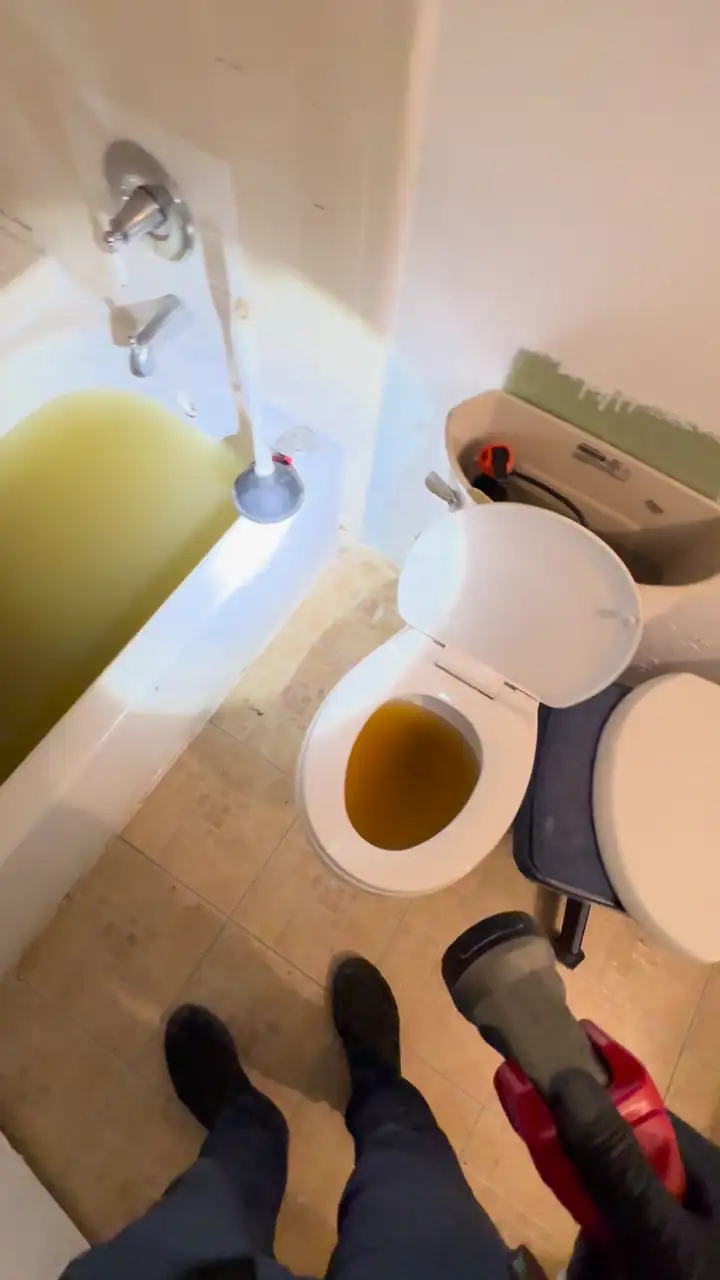
The water heater in the attic. A water heater in an attic can leak for half a year before anybody knows. A little water goes into the drain pan under it, the ceiling stays dry, and nobody goes up there to look. Then one day the tank overheats and the crack opens up. Now it's an active leak. A drain pan is made for a drip. It can't carry a stream, so the water goes over the side and through the ceiling.
A tank that's ten years old or more has a second problem. You go to close the valve above it, and the valve doesn't turn: ten years of rust and calcium. Then, when the supply lines are still in good shape, we take the heater off the line and connect the pipes straight through, around the tank. It's a temporary bypass. The house has cold water for the night, the tank gets drained so it stops dripping, and the new heater goes in on the nearest weekday. Putting in the new one is covered under water heater repair and replacement. The small expansion tank next to the heater can do the same thing: the copper it hangs on corrodes, or the tank was never connected right, and one day it lets go. In an attic that's a flood through the ceiling.

A recirculation pump that dripped all night. A Saturday morning call in February 2026. The family woke up, and the ceiling on the second floor was wet. In the attic above it sits the water heater, and next to it a recirculation pump, the small pump that keeps hot water moving through the lines. The house was about eight years old, and the pump was the original one, put in by the builder. It was a Grundfos, and that's a good manufacturer. But a recirculation pump usually wears out somewhere in its first ten years, and no brand is safe from that. This one worked its eight years and said goodbye: it cracked. It wasn't a hard leak. It dripped, steadily, all night, and by morning the ceiling was soaked.
That Saturday we took the pump out and ran a straight piece of pipe in its place, so the house had water and everything worked. Monday morning we picked up the new pump at the plumbing supply house we buy from, Ferguson in McKinney, came back and put it in. There was no reason to rush and buy a pump of unknown quality at a big box store. A plumbing supply house deals in plumbing and nothing else, and that's where the good material is.
A leak inside the garage wall. An evening call, right after a freeze: the garage floor was damp, the cabinets along the garage wall were wet inside, and outside, the brick on the front of the house was wet for ten or fifteen feet. It was a leak inside the wall. We traced it and opened the wall in the garage, and it turned out there used to be an outside spigot on that side of the house. Somebody took the old spigot out and never put a cap on the line. They cut the copper off inside the wall, squeezed the end of the pipe flat and ran solder over it. That was the whole repair, and it was wrong from the first day. It held until that freeze. The pipe froze a little, the ice pushed on it, and the soldered end came apart: a thin jet of water, spraying inside the wall. We cut the pipe back and put a press cap on it, the way that line should have been closed the first time.
After somebody else's work. Nine in the evening, and a family has no water in the house. That day a handyman, recommended by a friend, had come to change the outside spigot. He did it for half our price, far below the market. He unscrewed the old spigot, and the pipes inside the wall broke. He screwed the new one in and left. Water ran inside the wall, behind the drywall, for about two hours. Half an hour in, it was already standing on the garage floor. By the end all the insulation and the whole outside wall were wet.
Then the homeowner had to pay again. First us: an emergency call, the wall opened, the pipes inside it rebuilt. It came out to about three times what that spigot would have cost with a plumber on it from the start. After us came our restoration partner, to keep mold from spreading in that wall. A handyman has no right to do plumbing: plumbing in Texas is licensed work, and changing a spigot is plumbing. That means he has no insurance for plumbing either. His policy won't cover any of this.
A plumber who has changed a thousand of these spigots knows what is going on in that wall. When he starts to unscrew the old one, he can feel whether the elbow inside the wall is fastened down or not. That tells him how hard he can turn it, and whether it can be unscrewed at all. Somebody who does this once in a blue moon doesn't have that feel. We're not criticizing anybody. But we get a lot of calls like this one, and the people end up paying a lot more. Changing an outside spigot is hose bib repair. Let a licensed plumber do the plumbing. Our jobs run under our Responsible Master Plumber license, M-44816, and the board that issues those licenses is the Texas State Board of Plumbing Examiners.
Closet shelves, and a nail through the pipe. A handyman came to put up shelves in a closet. He nailed them to the wall and went through the PEX water line inside it. Water came shooting out of the line. Nothing too critical came of it. It happens, and nobody is immune to it. The one bad part: neither the homeowner nor the handyman could shut off the water to the house. It was an emergency call, and we had a crew free in that area, so we got there quickly and the leak didn't have time to spread. The key is knowing how to close the main shut-off valve. The homeowner has to know it and, strange as it sounds, so does the handyman.
A manifold made of push-fit fittings. A previous plumber had built a manifold inside a wall out of push-fit fittings. One of the fittings broke, and the water started flooding the house.
Burst Pipes After a Hard Freeze: Where They Break
Nobody can tell you ahead of time which pipe a hard freeze will take. But pipe breaks in a freeze come from the same few places.
In a garage it's the supply line in the wall that feeds the outside spigot, when that wall has no insulation. In the attic it's any pipe that runs bare through thin insulation, and a burst pipe up there floods the whole house under it. In older houses it's the pipes in outside walls, where there is little insulation. And after a hard freeze we get more calls for leaks under the slab. The ground under a house should be warmer than the air, and we can't tell you why it happens. It does, and that work is slab leak repair.

About half of these leaks don't show during the freeze. They show when everything starts to thaw and water gets back into the part of the pipe that split.
One winter emergency call. A pipe let go inside an outside wall and flooded in both directions, into the house and out through the wood siding. We opened the wall. The line was PEX put together with push-fit fittings. It had stretched and burst. We cut that part out and ran copper.

Before a freeze, let the faucets inside the house drip, and leave the cabinets under the sinks open. Leave the spigot outside alone: don't let it drip. A frost free spigot that was installed right doesn't freeze. What it needs is a cover. One that did freeze splits inside the wall and leaks only while it's in use, so nobody sees it for months. All summer we replace spigots that split the winter before: hose bib repair. And find the main shut-off valve before the cold comes.
Before It’s an Emergency: Find the Main Shut-Off Valve
Every leak on this page gets smaller when somebody in the house can close the water in the first minute. So find your main shut-off valve this week, while nothing is leaking, and show it to everybody who lives in the house. If it's buried, or you can't find it, or it looks like it hasn't moved in ten years, that's worth a weekday visit. It's better to learn it on a weekday than on the night you need it.
Two more things do a lot of the work. Have the water pressure checked once a year. Over 80 PSI the whole system is under stress, and the weak part gives first, a cartridge or a supply line.
The other one is an automatic water shut-off valve. It sits on the main line and watches the flow. When a pipe bursts and water moves the way it never does in normal use, the valve sends a message to your phone, and depending on how it's set up, it closes the water by itself. With sensors on the floor it reacts to the first water it feels. In a house with a water heater or water lines in the attic, that's a very useful thing to have. Our guide to automatic water shut-off valves covers what goes into one.
When the Water Has Already Done Damage
The pipe is our part of the job. Drying the house is a different trade. Drywall and subfloor that stay wet grow mold inside the wall, where nobody looks. That's what happened in the Plano house above, the first time. The drying is done by a restoration partner we trust. They dry the walls and the floors and open what has to be opened. They also deal with the insurance company. On an emergency we can come out together with their crew.
What your policy covers is between you and your insurer, and we won't promise anything about it. What you get from us is an invoice that says exactly what was repaired, and on the bigger jobs, photos and video of the work.
24 Hour Plumber Service Area: Frisco, Plano and the Cities Around Them
Emergency plumbing runs out of two offices, and the 24 hour plumbers on duty cover ten cities from them. An emergency plumber in Frisco and an emergency plumber in Plano work out of the offices in those two cities. The same line covers the rest. A call for a plumber in McKinney goes to the same people as a call for a plumber in Allen. It's that way for a plumber in Prosper and for a plumber in Celina, for a plumber in Little Elm and for a plumber in The Colony, for a plumber in Carrollton and for a plumber in Lewisville. We also come out to Highland Park and University Park. Anywhere else about a twenty minute drive from our Frisco or Plano office, call and ask. The arrival window you hear on the phone is for your address, not an average.
Emergency Plumbing FAQ
Do I pay the after hours fee if the repair turns out to be small?
The emergency fee goes with the hour of the call, not with the size of the repair. It's named before the plumber heads out, so you know it before you decide. The repair has its own flat price, and you hear that price before any work starts. If the job can wait for a weekday, we tell you on that same call, and then it's the $49 service call.
The valve behind my toilet will not stop the water. What do I do?
Close the main shut-off valve, and the water stops for the whole house. The little valves at toilets and sinks are often builder grade, and after years without being turned a lot of them don't close. With the main valve closed the toilet stops filling, and nothing else gets wet. The stop valve and the part inside the tank are a small job, and it's on the toilet repair page.
Water is coming through my ceiling. Where is it coming from?
Not always from the room right above the wet spot. Water runs along the framing and the pipes before it drops. On the Plano call above, the ceiling came down on the first floor, and the leak was inside a wall on the second floor, on the line that goes up to the water heater in the attic. Close the main shut-off valve first, so the ceiling stops taking water. Finding the spot is our part of the job.
My shower will not turn off. What do I do until the plumber gets here?
Close the main shut-off valve for the house. Most showers have no small valve of their own that you can reach, so the main valve is the way to stop the water. Don't keep forcing the handle: the cartridge inside is already broken. With the water off nothing is getting worse, but the house has no water until the cartridge is replaced. Call, and you hear the arrival window and the emergency fee for that hour.
Can you stop the leak tonight and do the full repair later?
Yes, when the full repair isn't night work. A water heater is the usual case. We take the leaking heater off the line, connect the pipes around it when they're in good shape, drain the tank, and set the new heater for the nearest weekday, with a city permit where the city requires one. A slab leak waits for daytime too. A burst pipe we can reach gets repaired that night.
Do you come out on Sundays and holidays?
Yes. Emergency plumbing runs 24/7, weekends and holidays included, with a licensed plumber on duty. The office keeps weekday hours, 8 AM to 5 PM, but the phones don't follow the office. On a Sunday or a holiday the emergency fee applies, and you hear the amount before anybody drives out.
What People Wrote After a Night Call
Two reviews, exactly as they were posted, with a link to each.
Reviews
Sunday night the faucet in my bathroom broke and there was water everywhere. I called a bunch of “24/7 emergency” plumbers and nobody answered but this company actually answered. They showed up and fixed it super fast. I don’t know what I would’ve done if they didn’t answer.
★★★★★ · Local Guide Level 2 · May 2025 · Google
Read on Google
FPP Plumbing came to our rescue! We had a shower that we could not turn off at 4AM, so we called FPP based on their 5-star rating. They answered the phone, asked us to text them our address and quickly and clearly responded what our options and prices were for each option. We scheduled a window for them to come out that morning, they showed up promptly and quickly assessed the situation. They were friendly, professional and put our minds at ease that the repair would be simple and quick. And it was! He even took the time to show us how to turn off the water to our house should we ever need to in the future. Highly recommend for any plumbing needs!
★★★★★ · Local Guide Level 2 · July 2025 · Google
Read on Google
If water is running right now, close it and call the office closest to you: the call buttons at the top of this page reach the Frisco and Plano lines, and both are answered at any hour. If it can wait, send the Request Service form and we'll set a weekday time.